

Introduction
Tobacco, scientifically known as Nicotiana tabacum, is a widely cultivated crop belonging to the Solanaceae family. It is grown primarily for its leaves, which are harvested, cured, and processed for consumption in various forms. Tobacco carries both economic and cultural weight, having been used across societies for centuries, and the plant adapts to a wide range of climates — with major production in North and South America, Asia, and Africa.
India is one of the largest producers of tobacco, contributing significantly to both domestic consumption and global exports. Cultivation is concentrated in Andhra Pradesh, Karnataka, Gujarat, Bihar, and Tamil Nadu, with Andhra Pradesh leading the country and accounting for roughly 50% of national tobacco yield.
Classification of tobacco diseases
Tobacco pathogens fall into three broad groups based on the causal agent. Identifying which group is in play determines whether the response is sanitation, vector control, resistant varieties, or biological agents.
Fungal and oomycete diseases
- Black Shank (Phytophthora nicotianae / parasitica)
- Damping Off (Pythium spp., Rhizoctonia solani)
- Frog Eye Spot / Cercospora Leaf Spot (Cercospora nicotianae)
- Brown Spot (Alternaria alternata)
- Target Spot (Rhizoctonia solani)
Viral diseases
- Tobacco Leaf Curl Virus (whitefly-transmitted)
- Tobacco Mosaic Virus (TMV)
Black Shank Disease
One of the most destructive diseases of tobacco, black shank is caused by Phytophthora nicotianae (P. parasitica var. nicotianae) — a soil-borne pathogen that infects plants at all growth stages. It produces characteristic black lesions at the base of the stem, leading to wilting, root rot, and eventual plant death. The disease thrives in poorly drained, moist soils and can cause yield losses ranging from 10% to complete crop failure under severe conditions.
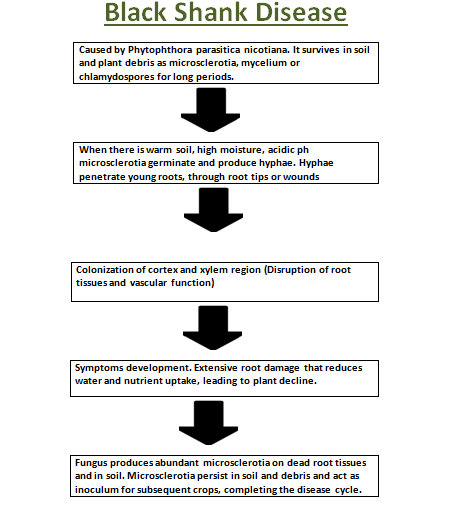
Mode of action and disease cycle
- 1Survives in soil and plant debris as microsclerotia, mycelium, or chlamydospores for long periods.
- 2Under warm soil, high moisture, and acidic pH, microsclerotia germinate and produce hyphae.
- 3Hyphae penetrate young roots through root tips or wounds.
- 4The pathogen colonises the cortex and xylem, disrupting root tissue and vascular function.
- 5Extensive root damage reduces water and nutrient uptake, driving wilting, blackening of the stem base, and plant decline.
- 6Abundant microsclerotia form on dead root tissue and return to the soil, completing the cycle and acting as inoculum for the next crop.
Damping Off
Damping off is caused by soil-borne pathogens such as Pythium spp. and Rhizoctonia solani, which lead to rotting of the stem at the soil surface — causing seedlings to collapse and die. The result is poor plant establishment and yield losses of up to 80% if not properly managed. The disease is most damaging in seedbeds with high humidity, dense sowing, and over-irrigation.
Frog Eye Spot (Cercospora Leaf Spot)
Frog eye spot, or Cercospora leaf spot, is caused by Cercospora nicotianae. It is characterised by circular lesions with a white or grey centre and dark margins, giving the classic "frog-eye" appearance. It mainly affects mature leaves, reducing photosynthetic activity and lowering cured-leaf quality, with yield losses typically between 10% and 30%.
Brown spot, caused by Alternaria alternata, presents similarly with brown necrotic lesions on older leaves, leading to deterioration in leaf quality and yield losses of around 5% to 20%. Together these two foliar pathogens can downgrade an otherwise healthy crop at the very stage where leaf quality determines its market value.
Target Spot of Tobacco
Target spot of tobacco, also caused by Rhizoctonia solani, is identified by concentric ring-like lesions that resemble a shooting target. It can affect plants at various stages of growth and may cause defoliation and significant yield reduction, ranging from 10% to 40%. The disease is favoured by extended leaf wetness in dense canopies.
Leaf Curl Disease
Leaf curl disease, caused by Tobacco leaf curl virus and transmitted by whiteflies (Bemisia tabaci), results in curling, yellowing, and stunted plant growth — particularly during the vegetative stage — leading to yield losses of 20% to 50%. Because the virus is whitefly-vectored, control is built around vector management and clean nursery practice rather than curative sprays.
Tobacco Mosaic Virus
Tobacco mosaic virus (TMV) produces a characteristic mosaic pattern of light and dark green patches on leaves, along with distortion and reduced growth. It significantly affects photosynthesis and cured-leaf quality, with yield losses ranging from 15% to 50%. TMV is mechanically transmitted — through hands, tools, and contaminated tobacco products — which makes hygiene a frontline control.
Etiology and epidemiology
- Soil-borne fungi and oomycetes (Phytophthora, Pythium, Rhizoctonia) survive between seasons in plant debris and persist in poorly drained, acidic soils.
- Foliar fungi (Cercospora, Alternaria) build up inoculum on lower leaves and spread upward as canopy humidity increases.
- Viruses depend either on insect vectors (whitefly for leaf curl) or mechanical transmission (TMV) — neither responds to fungicides.
- Warm temperatures, frequent rainfall or overhead irrigation, and continuous tobacco cropping all amplify disease pressure.
Management
Cultural and sanitary practices
- Use certified, disease-free seed and seedlings raised in clean nursery beds.
- Rotate tobacco with non-solanaceous crops to break soil-borne disease cycles, especially for black shank.
- Improve drainage and avoid acidic, waterlogged soils where Phytophthora thrives.
- Rogue and destroy virus-infected plants early to remove inoculum from the field.
- Disinfect hands, tools, and clothing to limit mechanical spread of TMV.
- Manage whiteflies with yellow sticky traps and insect-proof nets in nurseries to break the leaf-curl transmission cycle.
Resistant varieties and biocontrol
- Plant tobacco varieties with known resistance to local races of Phytophthora nicotianae and TMV where available.
- Treat seed and soil with Trichoderma spp. to suppress damping off and early black shank infection.
- Use Bacillus subtilis, Bacillus velezensis, and Pseudomonas fluorescens as root-zone inoculants to prime plant defences.
- Deploy entomopathogens such as Beauveria bassiana to suppress whitefly populations and indirectly limit leaf curl spread.
Quick yield-loss reference
- Black Shank: 10% to complete crop failure
- Damping Off: up to 80%
- Frog Eye Spot / Cercospora: 10–30%
- Brown Spot (Alternaria): 5–20%
- Target Spot: 10–40%
- Leaf Curl Disease: 20–50%
- Tobacco Mosaic Virus: 15–50%
Conclusion
Tobacco is one of the most economically significant crops in the world, but its yield and leaf quality are shaped almost entirely by how well disease pressure is managed. The pathogens covered above — soil-borne, foliar, and viral — collectively pose a major threat to tobacco cultivation, and their impact depends on environmental conditions, crop management practices, and how early control measures are deployed. Build the season around clean planting material, rotation, vector control, and microbial biocontrol, and the yield-loss numbers above stop being the default outcome.
Written by
Nikita Raj
Research Assistant
Research Assistant at exRNA Agro, working on tobacco (Nicotiana tabacum) disease diagnostics, pathogen biology, and integrated crop protection.