
Introduction
The banana plant (Musa spp.) is actually a large herbaceous perennial, not a tree, and it produces one of the most widely consumed fruits in the world. Globally, bananas are a cornerstone of food security and a crucial export commodity — rich in potassium, vitamins (C and B6), and dietary fibre, providing nutrition and income for millions of people across tropical and subtropical regions.
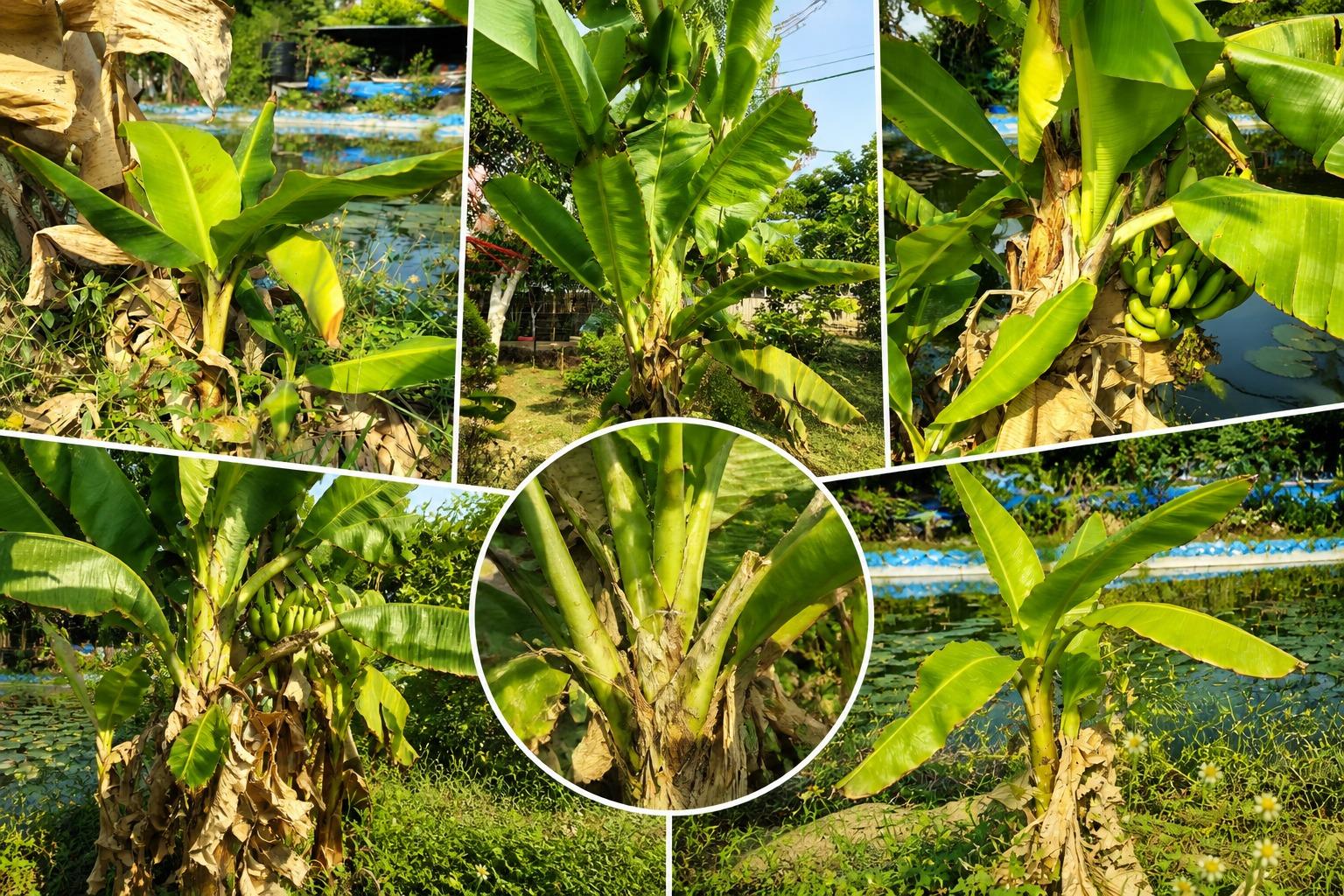
In India, the banana holds immense cultural, dietary, and economic significance. India is consistently the world's largest producer of bananas, cultivating a vast diversity of local varieties alongside the globally dominant Cavendish, and supporting the livelihoods of countless farmers across states.
Major banana diseases beyond Panama
Bananas are susceptible to several aggressive pathogens. Knowing the broader disease landscape matters because management decisions — fungicide cycles, vector control, sanitation, quarantine — depend on which pathogen group is in play.
Black Sigatoka (Black Leaf Streak)
Caused by Pseudocercospora fijiensis (syn. Mycosphaerella fijiensis). The most widespread and destructive foliar disease worldwide. Black streaks kill leaf tissue, reduce photosynthesis, and trigger premature fruit ripening — drastically lowering yield and fruit quality. Control depends on regular fungicide application; without it, yield losses run 35–50%.
Banana Bunchy Top Disease (BBTD)
Caused by Banana bunchy top virus (BBTV) in the family Nanoviridae. The most serious viral disease of banana in the Asia–Pacific region, transmitted by the banana aphid (Pentalonia nigronervosa). Infected plants are stunted, with narrow stiff leaves bunched at the apex, and fail to fruit. There is no cure — infected plants must be destroyed. Outbreaks can drive 100% crop failure in infected sites.
Anthracnose / Crown Rot
Caused by Colletotrichum musae (anamorph: Glomerella musarum). Produces dark sunken peel lesions, crown rot, and premature ripening. Most damage is post-harvest — losses occur during storage and transport, and warm humid transit conditions accelerate disease progress significantly. Control depends on careful humidity and temperature management in the supply chain. A major post-harvest disease, with losses of up to 40% in some markets.
Moko Disease (Bacterial Wilt)
Caused by Ralstonia solanacearum (Race 2, Biovar 1). Spread by insects, contaminated tools, and soil. Drives internal brown-to-black discolouration, wilting, and fruit rot. There is no effective chemical control — management relies entirely on quarantine and eradication. Significant in Colombia, Brazil, and the Caribbean.
Bract Mosaic Disease
Caused by Banana bract mosaic virus (BBrMV), genus Potyvirus. Produces spindle-shaped mosaic streaks on bracts, pseudostem, and midribs, leading to reduced bunch weight and malformed fruits. Transmitted by aphids in a non-persistent manner. Control depends on suppressing aphid populations to break transmission. An emerging threat in India, the Philippines, and Sri Lanka, and increasing across South and Southeast Asia.
Panama Disease: a major threat to bananas
Panama disease, specifically the Tropical Race 4 (TR4) strain of Fusarium oxysporum f. sp. cubense (Foc), is the lethal threat to the global banana industry. Foc TR4 is particularly dangerous because it is a soil-borne fungus that can survive in the ground for decades without a host — making infected land entirely unusable for traditional banana farming, even after the plantation has been removed.
TR4 has historic precedent. The original Race 1 strain of Foc destroyed the Gros Michel cultivar in the mid-20th century and forced the global industry to switch to the Cavendish. TR4 now attacks Cavendish — the variety on which the modern export trade is built — and the industry has no equally productive replacement ready at scale.
Disease symptoms
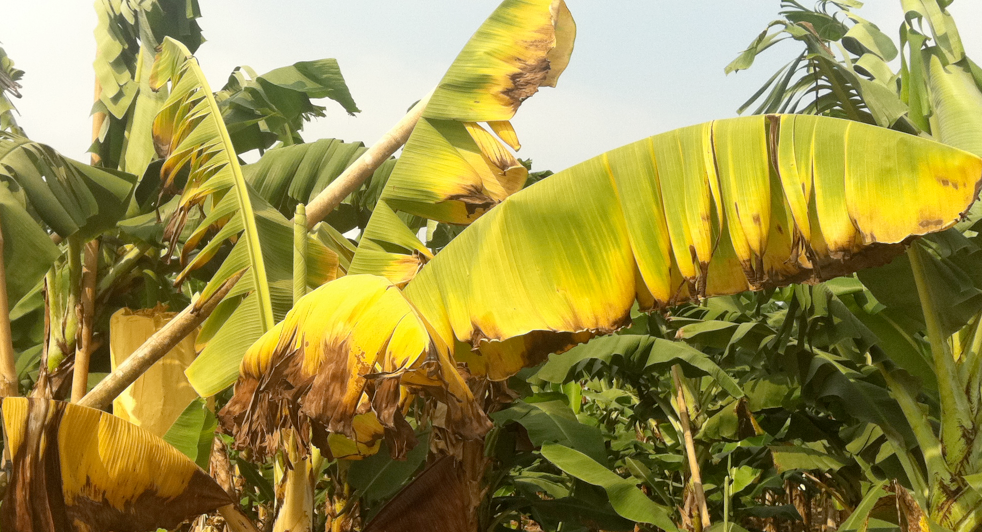
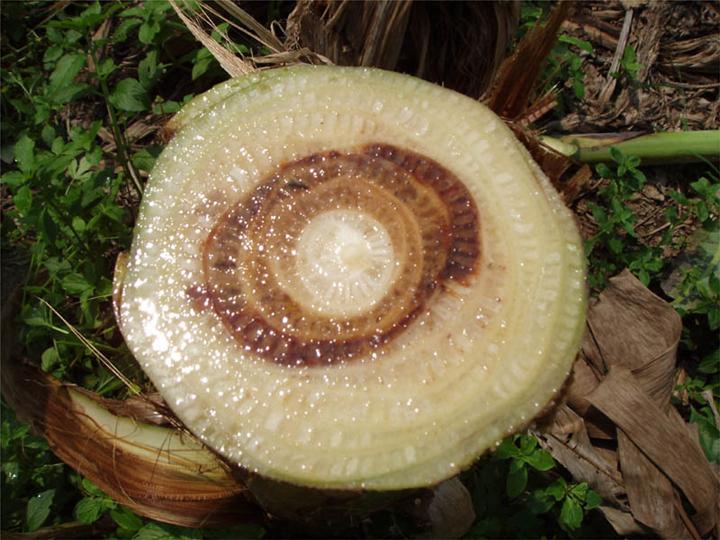
Panama disease causes yellowing and wilting of banana leaves, starting from the lower ones and spreading upwards. Infected plants show dark discoloration in the vascular tissue, stunted growth, and reduced yield. In severe cases, the plant may collapse, and roots appear discoloured or rotting.
Mechanism of action: how Foc TR4 attacks
Foc TR4 is not a foliar pathogen that gets sprayed off — it is a soil-borne fungus that infects from below and propagates inside the plant's plumbing. Understanding the cycle is what makes prevention rational.
- 1Resting spores in the soil come into contact with banana roots; they enter via root tips or through wounds caused by nematodes, machinery, or root pruning.
- 2Spores germinate and infect the cortical cells of the roots.
- 3The fungus colonises root tissue, and its hyphae invade intracellularly into the xylem vessels and move upward into the corm and pseudostem.
- 4Foc produces cell-wall-degrading enzymes and toxins, causing xylem-vessel occlusion, cell-wall breakdown, and blockage of water and nutrient transport.
- 5Disrupted physiology — impaired water and nutrient transport plus accumulation of toxic metabolites — leads to cellular damage and progressive wilting.
- 6The pseudostem develops yellow, brown, or red vascular discoloration; the plant eventually dies, and the fungus produces long-lived chlamydospores that survive in the soil for decades, ready to infect the next planting.
Disease treatment and biocontrol
There is no curative chemical treatment for Panama disease — fungicides cannot reach Foc inside the xylem, and soil fumigation is impractical at plantation scale and ecologically destructive. Sustainable banana cultivation therefore depends on a layered, prevention-first programme built around clean planting material, sanitation, resistant cultivars, and biological control.
Cultural and sanitary practices
- Plant tissue-cultured, certified disease-free suckers from accredited nurseries — never move suckers from a symptomatic block to a clean block
- Quarantine known-positive fields; restrict movement of soil, water, tools, and footwear between blocks to prevent chlamydospore dispersal
- Disinfect machinery, boots, and pruning tools between fields; install foot baths at field entrances in TR4-affected zones
- Remove and destroy symptomatic plants on-site rather than transporting them — burning or deep burial within the infected block reduces inoculum spread
- Manage drainage and avoid waterlogged soils, which favour spore movement and root infection
Resistant cultivars
Where TR4-tolerant or resistant varieties have been released by regional breeding programmes — including some Cavendish somaclonal variants and improved Musa hybrids — replanting on resistant material is the single most decisive long-term lever. Tolerance does not mean immunity, but it allows farmers to keep producing on land that would otherwise be lost.
Biocontrol agents
- Trichoderma spp. — soil and root inoculants that antagonise Fusarium in the rhizosphere and suppress early infection
- Bacillus subtilis and Bacillus velezensis — endophytic and rhizosphere colonisers that prime systemic plant defences and produce antifungal lipopeptides active against Foc
- Pseudomonas fluorescens — induces systemic resistance and supports root health under disease pressure
- Arbuscular mycorrhizal fungi (AMF) — improve root architecture and nutrient uptake, indirectly strengthening the plant's tolerance to Foc colonisation
Visual identification — at a glance
- Foliar: progressive yellowing of older, lower leaves first, advancing upward through the canopy while younger leaves remain greener for longer
- Pseudostem cross-section: concentric brown, red, or black rings of discoloured vascular tissue — the diagnostic Panama signature
- Roots and corm: discolouration, browning, and rot of the basal corm tissue, often with secondary pathogen colonisation
- Whole-plant: stunting, eventual collapse of the pseudostem, and failure to produce a marketable bunch
If a plant shows yellowing and wilting but the pseudostem cross-section is clean and white, look elsewhere — nutrient deficiency, drought, or BBTV, depending on the canopy pattern. The vascular ring is what separates Panama disease from everything else that can yellow a banana plant.
Quick yield-loss reference
- Black Sigatoka: 35–50% without fungicide programme
- Banana Bunchy Top Disease: up to 100% in infected sites
- Anthracnose / Crown Rot: up to 40% post-harvest
- Moko Disease: highly destructive in affected regions; controlled only by quarantine and eradication
- Bract Mosaic: significant bunch-weight reduction in endemic zones
- Panama Disease (Foc TR4): up to 100% in infected plantations, and decades of land unusable for susceptible cultivars
Conclusion
Bananas are one of the most economically and nutritionally important crops in the world, and India sits at the centre of global production. But the crop is uniquely vulnerable to a stack of foliar, viral, bacterial, and soil-borne diseases — and the soil-borne ones, led by Foc TR4, are the most consequential because they outlive the plants they kill. Build the plantation around clean, tissue-cultured planting material, layered sanitation, resistant cultivars where available, and microbial biocontrol — and the catastrophic 100% loss numbers stop being the default outcome.
Written by
Shristi Kumari
Research Assistant
Research Assistant at exRNA Agro, focused on banana crop health — Panama disease (Foc TR4) diagnostics, biocontrol-led management, and integrated disease strategy.