Introduction
Seedling diseases are among the most significant challenges in crop production, often causing poor germination, weak plant establishment, and substantial yield losses. Soil-borne pathogens responsible for damping-off and root rot can severely damage young plants during their most vulnerable growth stages. As concerns over chemical fungicide resistance and environmental sustainability continue to grow, exRNA-Agro Seed Coating has emerged as an effective and eco-friendly alternative for crop protection.
exRNA-Agro Seed Coating is an innovative biological seed treatment platform engineered to enhance seed germination, strengthen root development, improve early seedling vigour, and provide long-lasting protection against soil-borne diseases. Developed using environmentally responsible coating materials and next-generation formulation technology, it creates a thin, uniform protective layer around every seed — supporting rapid crop establishment while reducing reliance on conventional chemical seed treatments.
Why exRNA-Agro Seed Coating?
Modern agriculture requires seed treatments that not only protect crops from early-stage diseases but also improve overall crop performance. exRNA-Agro Seed Coating combines advanced coating technology with sustainable agricultural principles to support stronger crop establishment from the moment a seed is planted.
The precision-applied coating remains firmly attached to the seed during storage, transportation, and sowing before becoming active after planting. This creates an ideal environment for rapid germination, vigorous root development, improved plant health, and greater field uniformity.
What is biological seed coating?
exRNA-Agro Seed Coating is a biological seed treatment technique in which beneficial microbial extracts are applied to the seed surface using a natural polymer-based coating material. The coating forms a thin protective layer that adheres living beneficial microorganisms to the seed without affecting germination. After sowing, these microbes become active in the rhizosphere, colonise emerging roots, suppress harmful pathogens, and promote healthy plant development from the earliest stages of growth.
How beneficial Bacillus strains protect seeds
Beneficial microbial extracts provide multiple layers of protection: they produce natural antimicrobial compounds that inhibit disease-causing fungi, compete with pathogens for nutrients and space, and stimulate the plant's own defence mechanisms. At the same time, they enhance nutrient availability, improve root development, and release growth-promoting metabolites that support stronger, healthier seedlings.
Studies have shown that microbial seed coatings significantly improve seed germination, increase seedling vigour, promote longer root systems, and enhance plant growth compared with untreated seeds. Under disease pressure, these biological formulations substantially reduce seedling mortality caused by damping-off and root rot.
Microencapsulation: improving stability and performance
One of the major challenges in developing commercial microbial products is maintaining bacterial viability during storage and field application. Microencapsulation addresses this by enclosing beneficial Bacillus strains within natural gum-based biodegradable polymers, creating protective microcapsules that shield the bacteria from environmental stress while allowing their gradual release into the soil.
Among the natural encapsulation materials evaluated, alginate combined with natural plant gums demonstrated excellent encapsulation efficiency, sustained bacterial release for up to two months, and remarkable biological performance. Greenhouse studies reported complete suppression (100%) of take-all disease in wheat — highlighting the potential of controlled-release microbial formulations for long-lasting crop protection.
Key benefits
- Faster and more uniform seed germination
- Improved seedling vigour and crop establishment
- Enhanced root growth and nutrient uptake
- Effective protection against soil-borne diseases
- Stronger plant resilience during early growth
- Long-lasting coating stability and shelf life
- Environmentally responsible seed treatment
- Reduced dependence on conventional chemical fungicides
A sustainable future for seed treatment
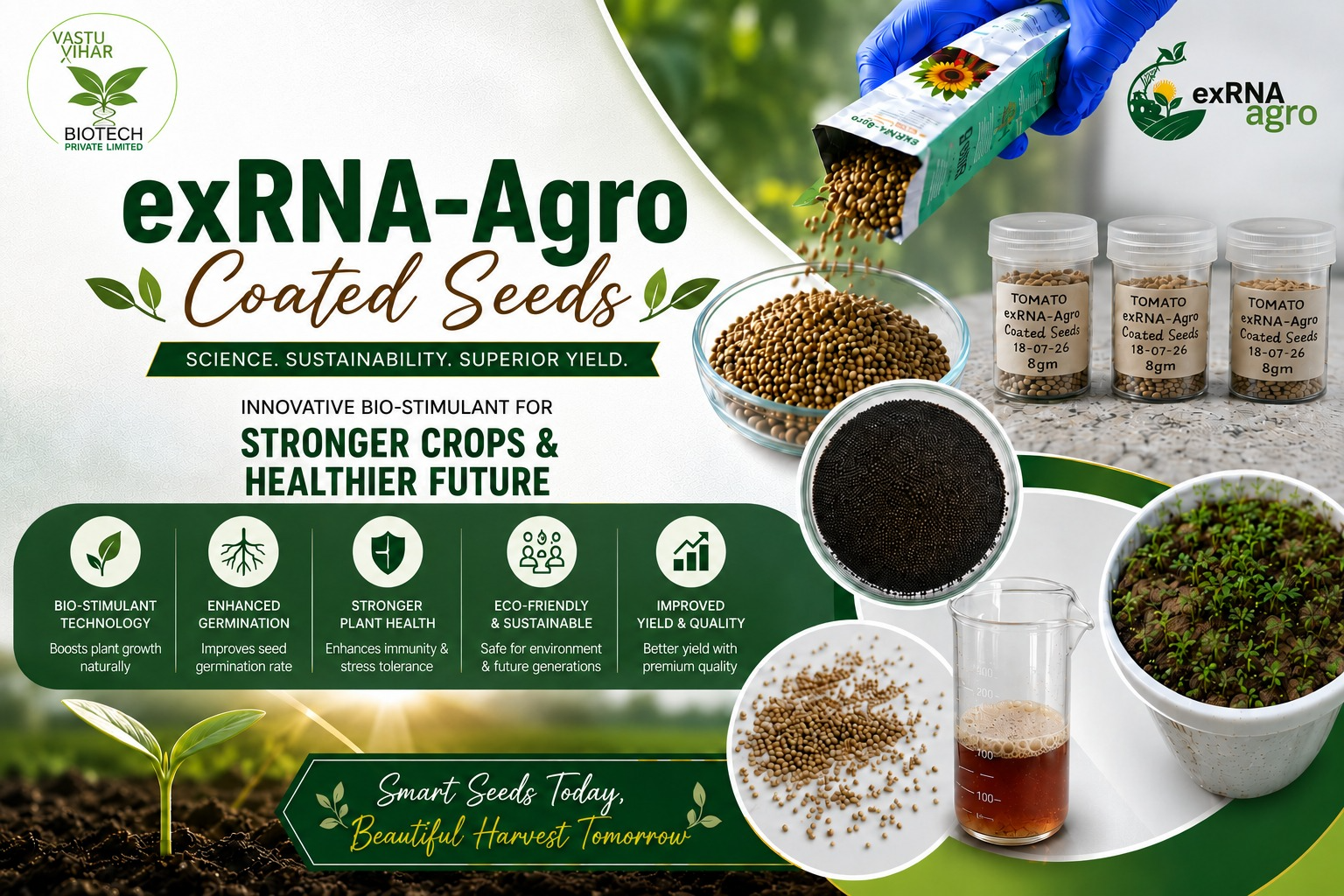
Modern microbial seed coatings combine disease management and plant-growth promotion in a single, environmentally friendly technology. By delivering beneficial microbial extracts directly to the seed, these formulations improve germination, strengthen root development, enhance early plant establishment, and reduce dependence on synthetic fungicides. The addition of natural gum-based microencapsulation further improves storage stability, bacterial survival, and field performance, making these bioformulations highly suitable for commercial agriculture.
Conclusion
As agriculture increasingly shifts toward sustainable production systems, biological seed coating represents a practical and scalable solution for improving crop health, increasing productivity, and protecting the environment. By pairing beneficial microbial extracts with natural, biodegradable coating materials and controlled-release microencapsulation, exRNA-Agro Seed Coating supports faster germination, stronger roots, and disease-free seedlings from the moment a seed is planted. With continued advances in biological formulations and controlled-release technologies, microbial seed coatings are expected to become a cornerstone of next-generation sustainable crop protection.
Written by
Kalpana Kumari
Research Assistant
Research Assistant at exRNA Agro, working on biological seed-coating platforms, microbial encapsulation, and greenhouse validation of sustainable seed-treatment technologies.