
Introduction
Amaranthus tricolor, commonly known as red amaranth or Lal Saag, is a short-duration leafy vegetable of the Amaranthaceae family that is widely cultivated across South Asia for its tender, nutrient-dense leaves. Because the harvestable part of the plant is the foliage, early vegetative growth largely determines crop quality and total harvestable biomass — every additional leaf, every centimetre of canopy, and every healthy root system at the seedling stage compounds into yield by the time the crop is cut.
This is exactly the window in which exRNA Agro is designed to act. exRNA Agro is a non-transgenic, bioinformatics-guided seed-treatment platform built on extracellular RNA (exRNA) technology. It is applied as a seed soak before sowing and is intended to support early crop establishment, vegetative growth, root development, and plant survival — without genetic modification of the crop itself. In a recent greenhouse study on Amaranthus tricolor under protected cultivation, treated plants outperformed water-treated controls across every growth parameter measured.
Why red amaranth is a good test crop
Amaranthus tricolor is a fast-growing C4 leafy vegetable that completes a marketable cycle in roughly 30–45 days. The leaves are valued nutritionally for their iron, calcium, and antioxidant pigments — the deep red and purple colouration of Lal Saag comes from betalain pigments concentrated in the leaves and stems. Because the cycle is short and the harvest is foliage rather than fruit or seed, treatments that delay early senescence and extend the active vegetative phase translate almost directly into harvestable yield.
From a research standpoint, this short cycle and the fact that yield is read off vegetative parameters — height, leaf number, stem diameter, root growth, and stand establishment — make red amaranth a clean model for evaluating a seed-applied biostimulant. Effects do not need to be inferred from late-season yield numbers; they show up in the first few weeks of growth.
The biology: SBT1.4 and senescence regulation
A central biological focus of the trial is the SBT1.4 gene. SBT1.4 encodes a subtilisin-like serine protease associated with plant senescence regulation and reproductive-stage development. During senescence, SBT1.4 contributes to protein degradation and nutrient remobilisation — the orderly breakdown and redistribution of cellular resources as tissues age. It is also linked to reproductive transitions, where it can influence branching, silique formation, and how the plant allocates resources between vegetative and reproductive organs.
In a leafy vegetable like Amaranthus tricolor, premature engagement of this senescence pathway is a problem. Once the plant begins reallocating resources out of leaves and stems, leaf production slows, canopy density drops, and overall vigour declines — exactly the parameters that determine market yield. Temporary, targeted downregulation of SBT1.4 may delay this premature shift, allowing the plant to remain in an active vegetative phase for longer. The biological hypothesis behind exRNA Agro on this crop is that modulating SBT1.4-associated activity at the seed stage carries forward into stronger early growth, denser canopies, and more robust root systems.
Why a non-transgenic, RNA-guided approach
Genetic modification of leafy vegetables faces both regulatory and consumer-acceptance hurdles, particularly in markets where Amaranthus tricolor is grown and sold. exRNA Agro avoids this entirely. The platform uses bioinformatics-designed extracellular RNA molecules applied as a seed soak — there is no insertion of foreign DNA into the plant, no inheritable change, and no GMO classification. The biology is the plant's own; the treatment simply nudges expression of a specific senescence-associated target during the early growth window.
Greenhouse trial design
The study was conducted in a greenhouse under protected cultivation, covering an observation period of approximately 45 days from sowing. Two groups of red amaranth plants were established side by side: an untreated control group, and an exRNA Agro-treated group whose seeds were soaked in the biostimulant prior to sowing. All other variables — substrate, irrigation regime, light exposure, and plot density — were held constant between the two groups, so any differences in growth could be attributed to the seed treatment.
At the end of the 45-day window, plants were assessed on six parameters: average plant height, leaf number per plant, stem diameter, root length, root diameter, and the number of surviving plants per plot. Together these metrics capture both individual plant vigour and stand-level establishment.
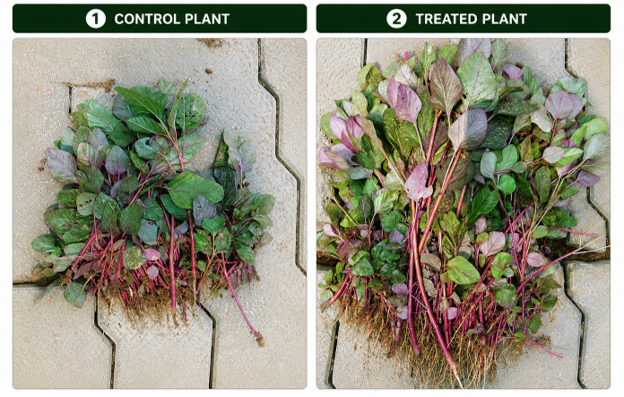
Results: control vs treated at 45 days
The two groups diverged sharply by harvest assessment. Untreated control plants grew, but stayed shorter, thinner, and less well established than the treated group. exRNA Agro-treated plants showed stronger vegetative growth above ground and stronger root development below ground, and the stand as a whole was far more uniform.
Untreated control (water-soaked seed)
- Average plant height: 7.25 inches
- Leaves per plant: 8.25
- Stem diameter: 3.86 mm
- Root length: 2.70 inches
- Root diameter: 2.99 mm
- Surviving plants per plot: 75
exRNA Agro-treated
- Average plant height: 15.25 inches
- Leaves per plant: 15.50
- Stem diameter: 6.87 mm
- Root length: 3.70 inches
- Root diameter: 5.54 mm
- Surviving plants per plot: 360
Interpreting the differences
The phenotypic pattern — taller, leafier, structurally stronger, better rooted, and more uniformly established plants — is consistent with the biological expectation of moderated senescence-associated activity at the early growth stage. When SBT1.4-driven protein degradation and nutrient remobilisation are not engaged prematurely, the plant continues investing in leaf expansion, shoot elongation, and root architecture rather than shifting into resource breakdown.
The survival number is the most striking single result. Going from 75 to 360 surviving plants per plot is not a marginal improvement in vigour — it is a step change in establishment. For a leafy crop where the harvest is the canopy itself, stand density is a yield multiplier on top of the per-plant gains in height, leaf number, and biomass.
For red amaranth specifically, where the leaves are the harvestable part, increased leaf number and improved plant vigour are exactly the traits that translate into market yield. The greenhouse data suggest that targeted modulation of a senescence-pathway gene through a seed-applied RNA biostimulant is a credible direction for improving leafy vegetable productivity in a sustainable, non-transgenic manner.
What this means for the platform
- exRNA Agro acts at the seed stage, before sowing — operationally simple to integrate into existing nursery and direct-seeding workflows.
- The mechanism is non-transgenic. There is no inheritable genetic change in the plant, which avoids GMO regulatory pathways and consumer-acceptance issues for leafy vegetables.
- The trial validates that a bioinformatics-designed RNA payload can produce measurable, biologically coherent improvements in vegetative growth on a real crop.
- Senescence-pathway modulation is a generalisable lever — the same logic applies to other short-duration leafy crops where vegetative phase length determines yield.
Conclusion
Across a 45-day greenhouse trial, Amaranthus tricolor seeds treated with exRNA Agro produced plants that were markedly taller, leafier, thicker-stemmed, better rooted, and more uniformly established than untreated controls — with stand survival roughly 4.8× higher. The results align with the biological hypothesis that temporary downregulation of the SBT1.4 senescence-associated protease can delay premature resource reallocation and extend the active vegetative phase. For a short-duration leafy vegetable, that is the part of the cycle that most directly translates into yield. Taken together, the trial supports exRNA Agro as a precision biostimulant approach — one that uses the plant's own RNA biology, applied at the seed stage, to support climate-resilient and sustainable leafy vegetable production without genetic modification.
Written by
Kalpana Kumari
Research Assistant
Research Assistant at exRNA Agro, working on extracellular RNA seed-treatment platforms, plant senescence regulation, and greenhouse validation of biostimulant technologies in leafy vegetables.